

How to export assets to a spreadsheet
In short: From the Assets page in the web portal, click Export Assets, choose which columns you want, and click Export. Keyhive builds the file in the background and drops a notification in the bell menu when it’s ready: download it as a .csv or an .xlsx (Excel) file.
When you’d do this: When you need your list of assets outside Keyhive, for a stock-take you can tick off on paper, a copy to hand to someone who doesn’t use Keyhive, a check that everything made it in after a big import, or a list you want to sort and mark up your own way.
Steps
-
Go to the Assets page in the web portal, via the Assets link in the sidebar.
-
Narrow the list first, if you want to. The export gives you exactly what the list is currently showing, so anything you do to the list before you export carries through to the file:
- Search. Type part of an asset’s name or description to narrow to those.
- Filter → Key set status. Pick assets whose keys are all out, all back, or where at least one set is currently with someone. Exporting all key sets out gives you a chase list you can work through away from the screen.
If you want everything, clear the search and leave the filters alone.
-
Click Export Assets at the top of the list.
-
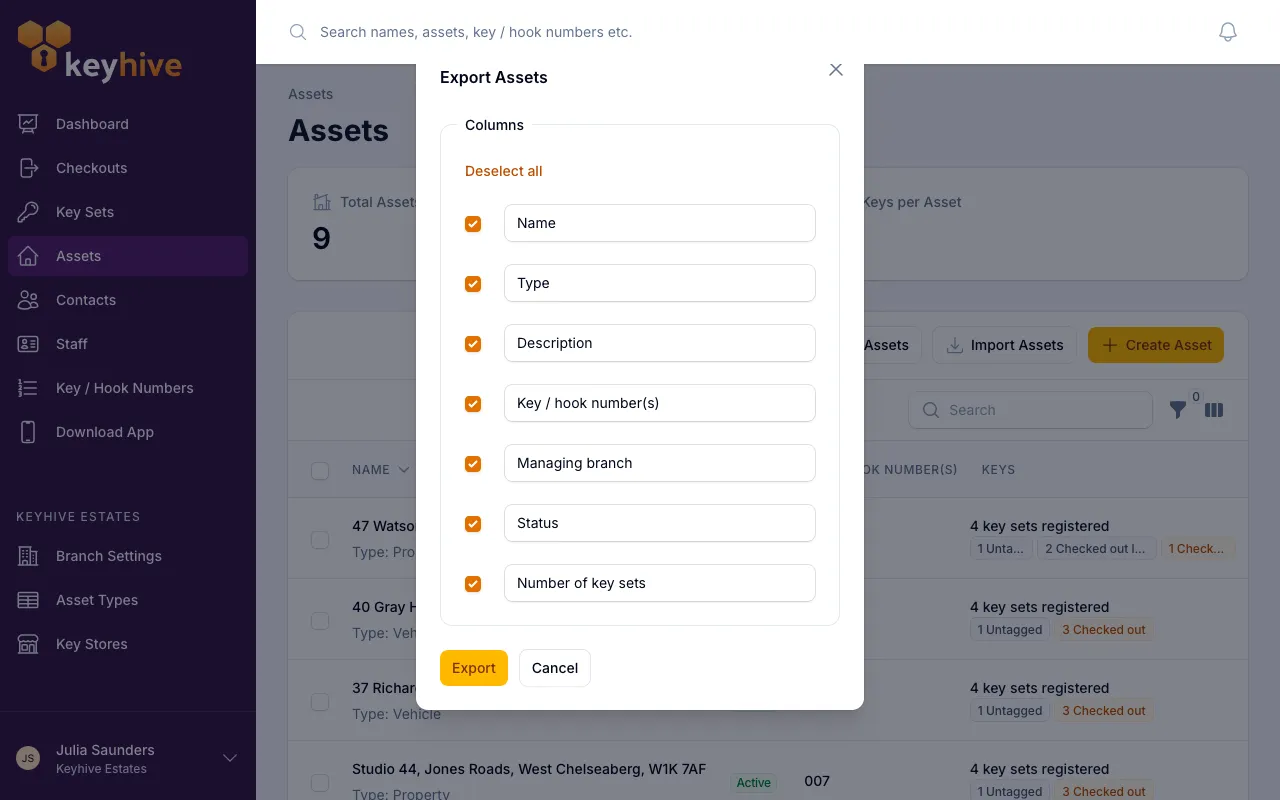
Choose your columns. A window opens listing everything that can go in the file. Untick anything you don’t need, or click Deselect all and tick just the few you want.
-
Click Export. The window closes and Keyhive starts building the file in the background. You can carry on working, or leave the page.
-
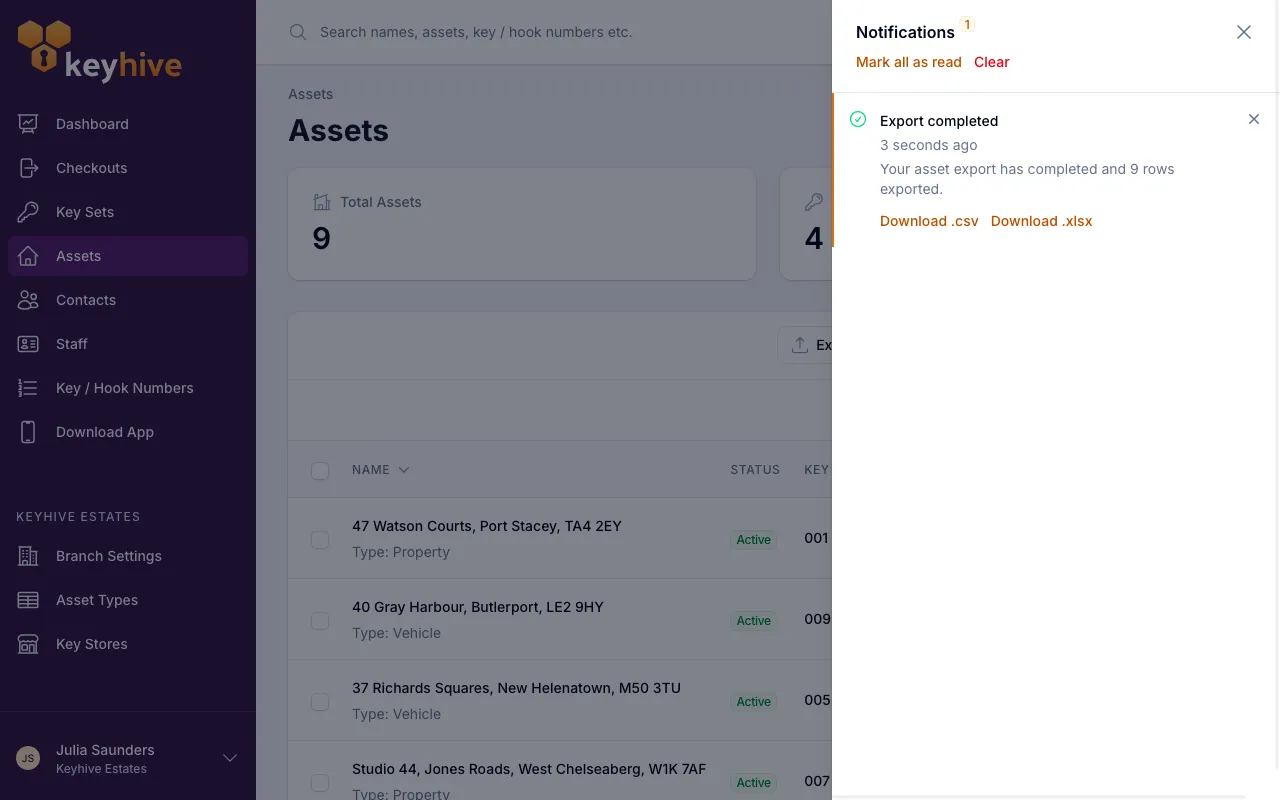
Download the file from the bell. When it’s ready, the bell icon in the top bar gets a red badge. Click it and you’ll see Export completed, telling you how many rows were exported, with two links:
- Download .csv. Opens in any spreadsheet program, and is the safe choice for feeding into another system.
- Download .xlsx. An Excel file, tidier to read and print.
Click whichever you need and the file saves to your computer.
Good to know
- One row per asset, not per key set. An asset with three sets of keys is still one row. The number of sets is a column on it. If you want a line per set of keys, export your key sets instead.
- Archived assets aren’t included unless you change the Archived filter before you export.
- Big lists take a little longer. The file is built in the background exactly so a large export doesn’t tie up your screen. If the notification hasn’t appeared yet, give it a moment. It’ll arrive on its own.
- The notification waits for you. It stays in the bell menu until you clear it, so you can come back to the download later. Once you’ve cleared it, run the export again to get a fresh file.
- It’s not an import file. An export is for reading, not for uploading back. If you’re adding or updating assets, start from the example file in the import window instead. The one exception is filling in key / hook numbers in bulk, where you copy the exported names into the example file. See How to bulk assign key / hook numbers to assets.
- Exporting changes nothing. It’s read-only: no asset is altered, archived or moved by exporting it.