

How to label and organise your keys
In short: Number the places keys hang (hooks, trays, pegs, drawers) rather than the keys themselves. Give every key set its own short identifier, so its name is the number plus that identifier: 52A, 624 Office. Put a written keyring label saying exactly that on the ring, alongside the Keyhive fob. Never write what the keys open on the keys.
When you’d do this: When you’re setting Keyhive up and going through your keys for the first time. Most people audit their keys at this point anyway, and labelling them as you go means each set is findable by the time you hang it back. The same scheme applies to every new set that comes in afterwards.
The scheme
1. Number the storage, not the keys. Hooks, pegs, trays, drawers, slots:
whatever your keys hang or sit in gets a number of its own, written on the
storage. 001, 52, 624.
2. Give every set its own identifier. One thing often has several sets of keys, one for the office, a spare, one that lives with a contractor. They hang in the same place, so they share the number. A short identifier tells them apart: letters (A, B, C), words (Office, Spare, Contractor) or colours (Red, Green, Yellow).
3. The set’s name is the number plus the identifier. That gives you 52A, 52B, 52C, or 624 Office, 624 Spare. This is the name that goes on the physical label and into Keyhive, so the two always read the same.
4. Put a written label on the ring. A keyring label with the set’s name on it, alongside the Keyhive fob. Anyone holding the keys can read where they came from and where they go back, without a device in their hand.
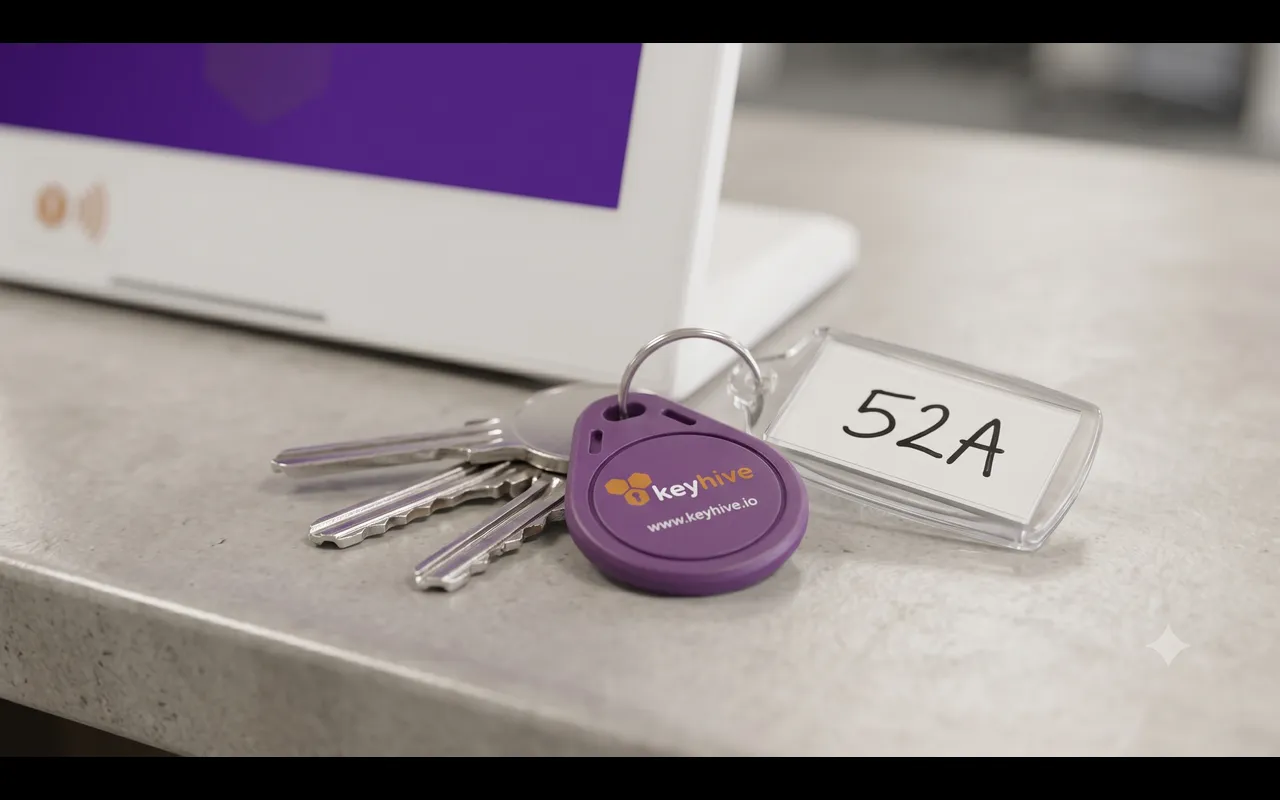
5. Nothing on the keys says what they open. See below.
Keyring labels are supplied by us. Ask your account manager for more when you need them.
Never write the address on the keys
Whatever is written on a key set is readable by anyone who finds it, so it must not identify what the keys open. No address, no name, no unit or door number, no registration.
A label reading 52A means nothing to a stranger. It only means something to
someone with access to your Keyhive account, because that’s where the link
between the number and the thing it opens is kept. The fob is the same: it
identifies the set to Keyhive and nothing else.
This is also why the number is worth keeping short and neutral. 52A is safe;
52A Flat 3 Mill St is a set of keys to a known address.
Match the label to Keyhive
The name you write on the keyring label is the name you give the set in Keyhive. When someone searches, scans or reads a checkout record, they see the same thing that’s in their hand.
- Add the numbers to Keyhive so it can tell you which hooks are free. See Understanding key / hook numbers and How to create a key / hook number. If you already have a numbered board, import the whole list at once rather than typing them in.
- Give the number to the asset, not to each set of keys. Every key set for that asset then carries the number automatically. See How to assign a key / hook number to an asset.
- Put only the identifier in the set name. The number is
52and the set name isA; Keyhive puts them together and calls the set52A. Typing52Aas the set name gives you52AA. - Name the asset the way your team says it out loud, because that’s what people search for. The asset carries the address; the keys don’t.
See How to create a key set for adding the sets themselves.
If you don’t use numbered hooks
Key / hook numbers are optional, and plenty of setups don’t have anything to number: keys in a safe, in a van, in a pouch. Everything else in this article still applies:
- Every set still needs a short, unique name you invent, such as a running number, a code, whatever your team will read out. It goes on the keyring label and into Keyhive as the set name.
- It still must not say what the keys open.
- The fob is what finds the keys. Scanning it brings up the set wherever it is, so you don’t need a numbered spot to work.
If your keys live in more than one place, an office and a van, say, Keyhive can track which one each set is sitting in. See Understanding key stores.
Good to know
- Numbers are reused. When you finish with something and archive it, its number is freed for the next one. The label on the hook stays; the keys on it change over the years. So don’t treat a number as a permanent name for a particular address.
- Two sets can’t share a number and identifier. That’s the point of the
identifier:
52Aand52Bhang together and are still told apart. - Relabel a set and rename it in Keyhive at the same time. The record is useless if the ring says one thing and the system says another. See How to view and edit a key set.
- A photo settles what a label can’t. A picture of the keys attached to the set records how many keys are on the ring and what state they’re in. See How to add a photo of a key set.
- Keys with no fob can’t go out. However well labelled a set is, it needs a Keyhive fob before it can be checked out. See How to assign a fob to a key set.